Loading
Showing posts with label Jaipur. Show all posts

Saturday, March 14, 2015

Rajasthan 2015 - Feb 6th - Day 3: Jaipur Sightseeing: Amer fort and more

To read the previous instalment, click HERE.

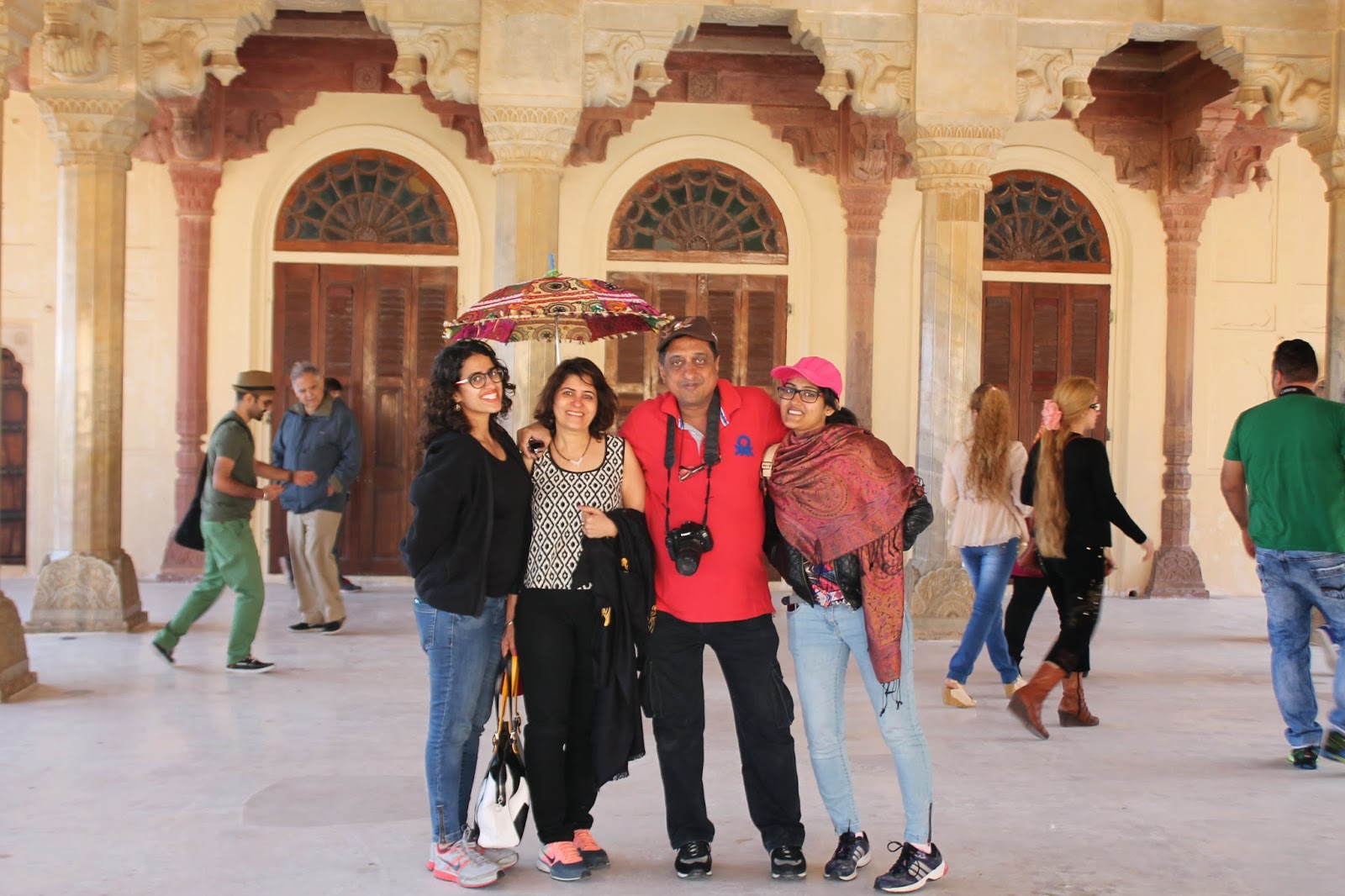
Today morning, our family went early to catch the elephant ride from the base to the top of Amer Fort. This is an unique thing in Amer. Amer Fort is a historically rich fort that we glimpsed yesterday evening through the sound and light show. Today, we were going to actually go in and see the various beautiful buildings constructed within the ramparts and walls of the fort. To do this, one can go up by a car from a different path, or, one can ride an elephant. Two people sit inside the howdah, while a mahout sits just behind the head of the giant animal and controls it. Each elephant costs Rs. 900/= to take you to the top, a journey of about a kilometer. There are long queues to get atop the elephants, and we used the extra time to look around, take photos and generally enjoy ourselves. Here are a few of those pictures. The special wound-cloth caps that we are wearing were borrowed from the seller for a princely amount of Rs. 10/- each. The umbrella is something we purchased (Rs. 200, down from the seller's demand of Rs. 450) ... and boy, this was a really useful purchase for the remnant of our entire holiday. This is because Nishrin hates the sun, and Rajasthan is an awfully sunny place to be in, regardless of which exact place you are at!


The elephants we rode on were docile and swayed from side to side as they limbered up the stone pathways, and as we climbed higher, we could see the entire landscape around us. Right opposite us, we could see the outer walls of the erstwhile Amer fort; behind us was the current Amer town; spread out below us were the beautifully landscaped gardens of the fort (there were three in all, each at different levels from each other), and these were interspersed with canopies of different sizes, velvet-like grass and colours of flower beds, and water bodies. Truly, a lovely ride.


Amer Fort is a tourists' delight. The treasures within are so many and so diverse! We hired a guide, who took us past the intricately decorated main gate and into the palaces within the fort. Here are some pictures of the sights we saw.

The Diwan-e-Aam


Ganesh Pol (gate) has this statuette of Lord Ganesh embedded in it.


Pillars from the Diwan-e-Aam
Detail of the cupolas inside Ganesh Pol


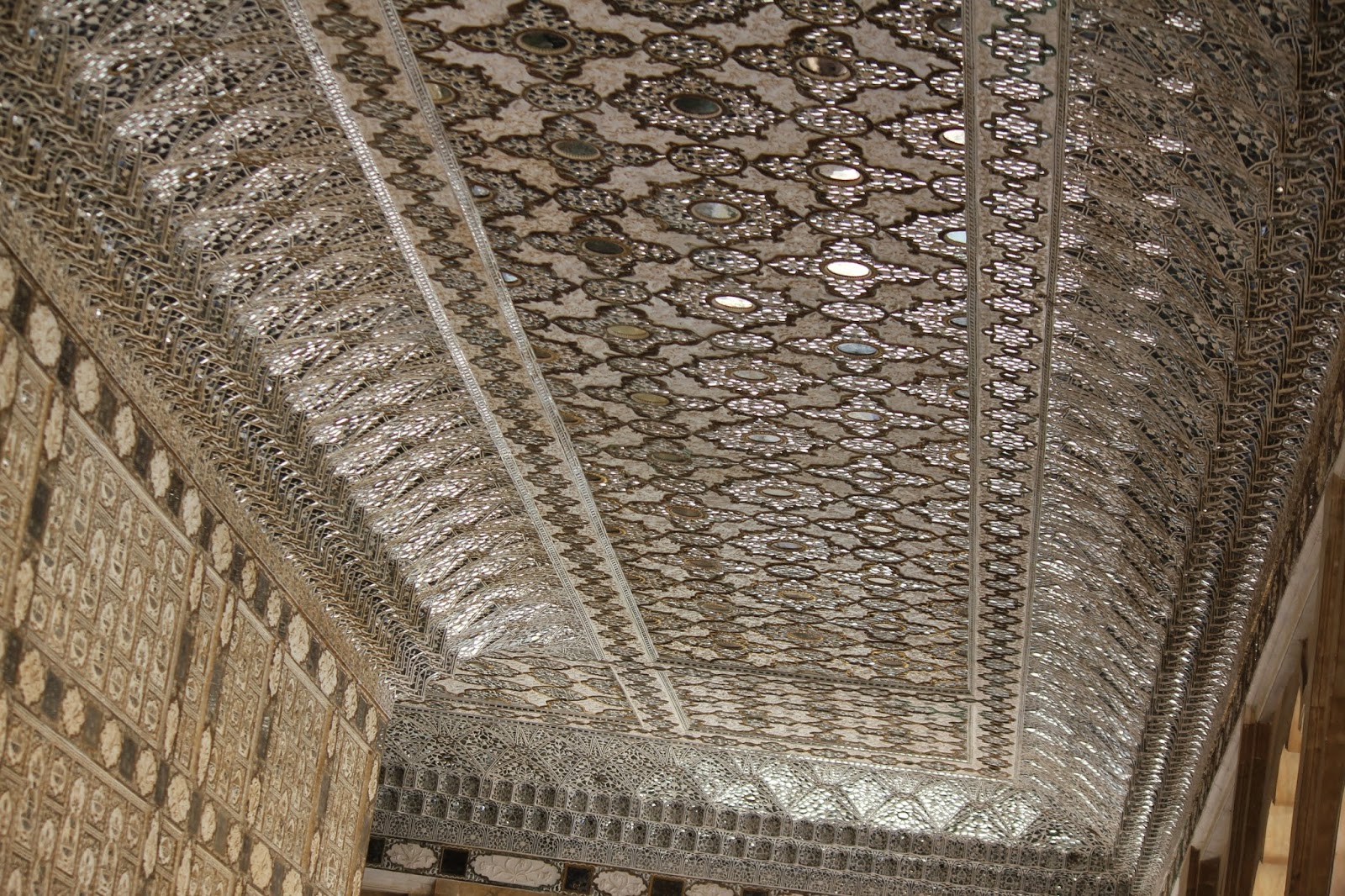
Sheesh Mahal - the ceiling

Sheesh Mahal - the wall

Frescos made from Belgian glass inside the Sheesh Mahal
An extra-ordinary grill made from stone and marble

Playing with mirrors
After the long and exhausting visit to the rest of the fort,  our driver took us to a place known as "Maharaja Restaurant". This was a clean, relatively sparsely furnished touristy diner where we had a passable meal. Next, we proceeded to go to the Nahargarh Fort in the late afternoon. The plan was to see the place and then watch the sun set from either the roof of the fort or to go to a cafe nearby which is known for excellent views of the setting sun. Truth be told, we reached Nahargarh almost after 4 p.m., as it is located nearly 15 km from Amer. The fort was nothing extra-ordinary, but, even so, the rooms and the carvings here were nice. We could not take the car inside, and Nishrin opted out of the visit and stayed in the car. We avoided taking a guide, and so finished the round of the main building within 45 minutes. After this, we ascended to the roof and waited for the sun to set. They told us that the fort would shut for the day at 6 p.m. Hence, we decided to go to the cafe to watch the sun set. The cafe charges an entry fee of Rs. 50 per person, but offers a free soft-drink or tea to compensate for the charge; we never did go in as Nishrin was fast asleep in the car, and the driver wanted us to go back to our hotel in Jaipur. Thus, we left the fort by half-past-six and returned to Jaipur, but before we went back to the hotel, we went to the local markets and shopped for things. 

Some photos from Nahargarh:


After Nahargarh, we returned to the city and then went for shopping. I visited a Raymond's shop and gave an order to stitch a Jaipuri "achkan", a sort of inner coat, but more sophisticated as it has to be worn outside one's shirt. Next, I contacted my friend Dr. Sanjay Shukla, who is a Jaipur resident. With him, I went out to eat as the others were not in the mood for dinner. I eventually purchased some stuff from McDonalds and then went back to the hotel for the night.

For the enxt instalment, click HERE.

Thanks for reading!!

Friday, March 06, 2015

Rajasthan 2015 - Feb 5th - Day 2: Jaipur sight-seeing II: Jantar Mantar, and Amer Fort S/L show

Let me go back to the evening of the 2nd day. What we did after completing the visits to Hawa Mahal and the City Palace is as follows:

One of the past kings (Sawai Jai Singh the IInd) was so enamoured by the joint sciences of astrology and its dependence on astronomy that he contracted the construction of architectural outdoor observatories in five Indian cities - Benares, Ujjain, Delhi, Mathura, and Jaipur. Of all the laboratories he constructed, the one at Jaipur was his last one, and as it has been maintained and repaired well, it is also the best preserved of all.

Since Jantar means instrument and Mantar means formula/calculation, Jantar Mantar essentially means "Calculations Instrument". We arrived here after finishing the visit to the City Palace. The huge slanted-top wall of one of the time-calculating structures was something we had already seen from the ramparts of the City Palace. Now, it was time to go deeper into the mysteries of this unique form of astronomical observatory. 

As I have said before, the scientists of that time used to rely a lot on astrology - and were, in fact, astrologers first. They used the knowledge of astronomical values and positions to derive "birth-charts" (kundlis) and also decide what the most propitious time would be for royal functions like weddings, engagements, coronations, war, etc. The remarkable gadgets and structures of JM are, however, not just gadgets. They are designed to clearly give information on celestial events like movements of stars, occurrence of eclipses, dates of equinoxes and solstices, planetary motion, and so on and so forth. The knowledgeable guide we had with us (he seemed to be a science-person, and his fees were a bit high, since the information he imparted was scientific and technical) helped us to navigate through the maze of these very unusual machines.  Here are some pictures. Those who desire more knowledge on these labs may consult THIS link.

Small sun-dial

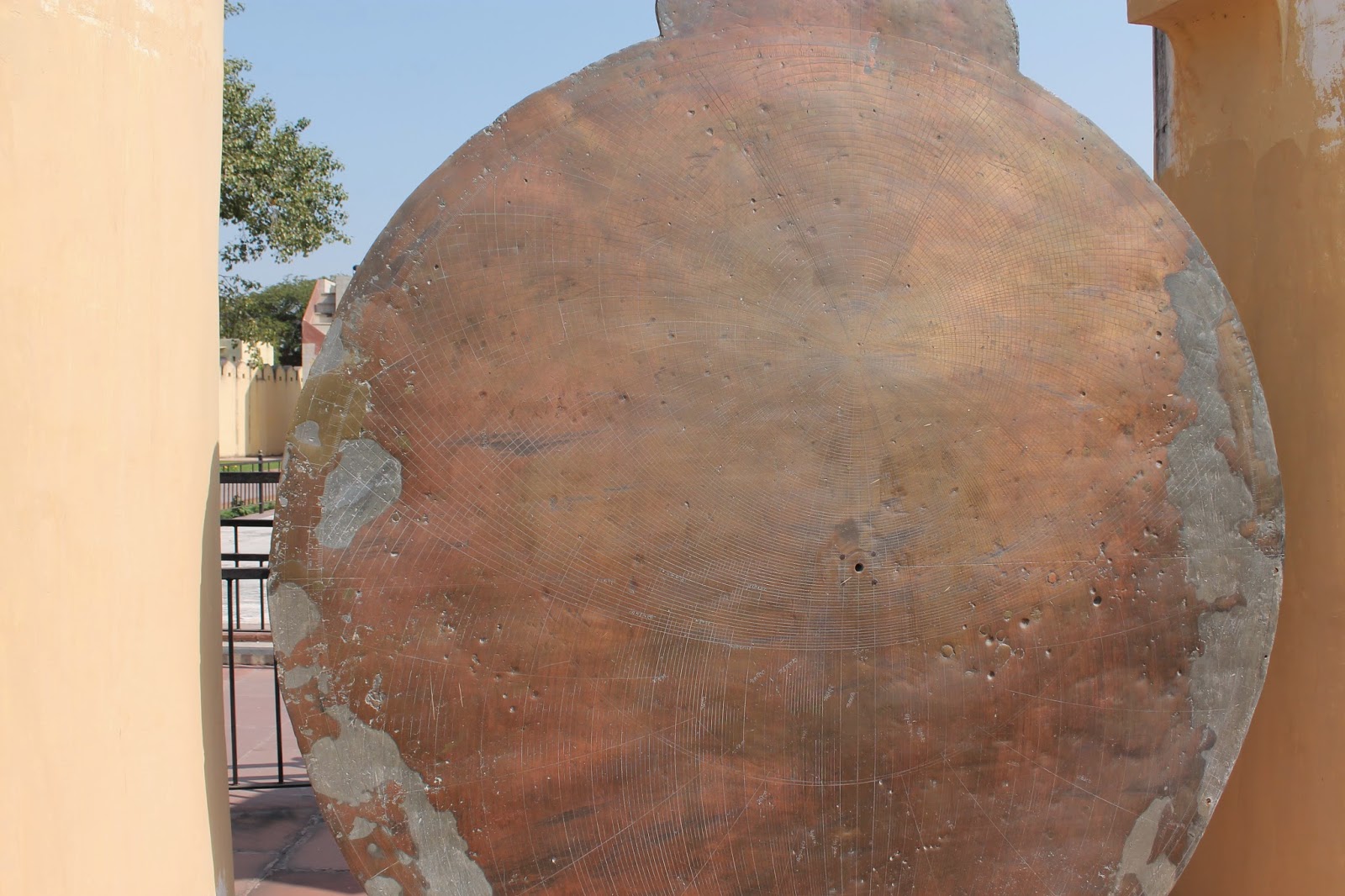
Description of the Nadivalaya


Helps to locate the position of sun/moon/planets w.r.t. constellations
Twelve such machines represent one zodiac each
To understand the position of the sun/planets w.r.t. their height and so on.


From there, we went to see the much-touted sound and light show at the Amber Fort, located at Amber city, 11 km from Jaipur. The show was good, but not extra-ordinary. The lighted walls of the fort and its various landmarks were great - it's just that they were very far off, and hence, not as effective as they could have been had they been a more modern source of light such as laser. The stories of the kings of Rajasthan and their interaction with the ruling Mughal dynasty were captivating and interlaced with soulful and stirring musical passages of sadness and celebration. Photography was not allowed, and we had to leave our digital cameras in the SUV, minded by our driver Jitu, who had parked about a km away. However, when we left the theater, he was back at the entrance of the S/L show. We returned to our hotel and spent the rest of the evening recuperating, but not before a short but necessary diversion to the local Bapu Market for shopping. We bought some excellent bed-sheets and pillow-covers for the house, and I also purchased a gift of a single bed-sheet for my mom.

Thursday, February 19, 2015

Rajasthan 2015 - Feb 5th - Day 2: Jaipur Sight-seeing I

To read the previous post, click HERE.

We began our drive-back from Ranthambore to Jaipur the next morning. Before we left, we took a good breakfast in the dining hall of the Tiger Machan. Our driver came by at half past eight, and presently, we were on the road back to Jaipur. The road to Jaipur from Ranthambore is pretty straightforward, as it goes over NH 62, also known as Sawai Mansingh Road all the way from Jaipur for several miles.

On the way, we stopped (and not just today, but pretty much on all travelling days) at a road-side canteen to have tea and biscuits. We reached Jaipur around 12.30 p.m. Instead of proceeding to our hotel, we began Jaipur sight-seeing from today itself. The itinerary was to go to Amer and see its famous fort and palace today, but as it transpired, we realised that it would be futile to go to Amer today as the elephant rides from the base of Amer fort to its top are closed after noon each day. Hence, we decided to visit the other attractions of Jaipur today.

We began with a visit to the famous HAWA MAHAL - the five-storeyed palace of an erstwhile king that symbolises Jaipur as nothing else. This is a magnificent structure that looks like a cardboard cut-out from the outside, but expands into a huge building once you enter it from a non-specific gateway that is situated inside a niche next to a garments shop. We hired a guide, who, as it turned out, also knew French and Russian. He would regale Hannah with his French, and after we had finished, we found him entertaining a Russian female with a native Russian song.

The palace itself has five floors, each signifying something different. As you ascend upwards (there are ramps and long passages to climb up, and stairs only occasionally), the rooms become slightly smaller, until, at the very top, you see spires, domes and small rooms with look-outs for the Jaipuri royal women. We learned that Hawa Mahal was meant only for the royal females, who, in those times, had to stay behind walls, and reveal nothing of themselves. They were allowed to "look out" of small face-windows, of which there were tens on each floor. Here are some pics we took.


After this, we went to visit to the CITY PALACE. This is a private palace owned by the present king of Jaipur. He loans out the grounds to the people at large to conduct their weddings, so, when we arrived there, preparations were on for a new wedding for that evening. It was immediately apparent that this was no ordinary people's wedding, but something exclusive - for some billionaire family. The mandap was huge; floral decorations alone would have cost lakhs of rupees, since they were mostly made from imported flowers. 

Outside the main gate
This is the portion you enter once you go in
This is 1 of the two silver pots the ex-king filled with Ganga-jal and took with him to London in the 1960s
Floral decorations for an evening wedding

After this, when we entered the palace proper, there was a stiff camera fee, so we passed. Whenever we had the chance, we took pictures with our mobiles. It was a good palace, no doubt. There have been additions made to it by successive kings over the past 400 or more years. However, the present king still lives here in one of the large wings of the palace. 

To read the next instalment, click HERE
.

My Trip Advisor on Jaipur

Rajasthan 2015 - Feb 4th: Day 1: Mumbai - Jaipur Airport - Ranthambore

To read the overview of the trip click HERE.

We had an early flight (0550 hours) from the Mumbai domestic terminal, and we arrived in Jaipur at a little after 0700 hours. It was a good, though a no-frills flight from Go Air. Our baggage was a bit overweight (4 kg, in fact), but they allowed us to go through. The airport at Jaipur is a small one, with just one baggage retrieval carousel. We got our bags pretty soon, and when we emerged outside, our travel driver, one Mr. Jitu (Jitendra Singh Rajawar) was waiting for us with his Toyota Innova. He is a humble, very nice and useful man, and would be the driver to choose if one wants to travel inside Rajasthan as well as in the places around this state, and if one wants, I can happily share his telephone numbers with them. He drives a company car, though, so you would have to negotiate with his company to get him to be your driver. 

His car was always spic and span. Although it is a relatively new car, you know what happens when the driver chooses not to keep the vehicle clean. Well, Jitu is a real oddball when it comes to maintaining himself and his car. Always dressed in neat clothes, he is athletic too, and walks or runs 6-7 km daily! His demeanour is HUMILITY itself; even that day, he stood with a placard bearing my name, but once I had waved at him to acknowledge his presence, he dropped the placard and folded both his hands in the umiversal gesture of bowing with a "Namaste". He quickly brought his car to the gate and we boarded all our pieces of luggage. The seating was 6 + driver, and while Nishrin occupied one of the middle row seats and Inas likewise, Hannah migrated to the back and I, next to the driver. While some bags were loaded on the top-carrier, many of the small bags fit nicely next to the rear seat. Thus, we left Jaipur airport. Our destination for the day: a direct drive to Ranthambore.

RANTHAMBORE

We checked into a tent-based accommodation at Ranthambore. This place is called Tiger Machan, and it is located just a few km away from the main gate of the National Park. We settled in, Nishrin and I in one tent, and the kids in an adjoining one (Tent nos. 2 and 3), and after some relaxation, we roamed around the grounds, played a bit of badminton, and so on, until we were called for lunch in the dining hall. The lunch was a simple affair of well-cooked food with one chicken item and the rest vegetarian ones. Shortly, we were called to be informed that the "canter", a 20-seater open vehicle that would take us on a Tiger Safari into the park had already arrived, and could we please go there and board it. So, we went. The canter is a strange open-ceilinged vehicle that allows tourists to sit on 2 by 2 seats. It tumbles and rumbles as it drives over rough roads. But it is the ideal safe vehicle from which one should watch big cats and other dangerous animals. 

RANTHAMBORE NATIONAL PARK

Located 160 km from Jaipur and within 10-12 km from Sawai Madhopur town, Ranthambore National Park is one of the largest national parks in India. A quick reading at Wikipedia will give many more details. We purchased tickets for the Tiger Safari (each ticket costing 750 rupees) - from the hotel's manager-cum-owner Mr. Shailendra Singh. Thus, when the canter arrived, we were ready!


After entering the park's tiger reserve, anticipation climbed steadily on us spotting tigers. Our guide, a rustic middle-aged man, composed us by claiming that with him at the helm, we would certainly see tigers. He, however, laid down some rules on tiger-spotting, such as maintaining silence, not throwing food or other things at animals, etc. He also assured camera enthusiasts such as I that he would give us good opportunities to shoot - but we should learn to be patient, and be ready to click at a moment's notice. Sure, said I. Our canter moved on.

After a drive past a lake that had several species of waders and ducks, the guide took us deeper into the deciduous forest, until we came to a spot where there were several jeeps and a few other canters parked. Across a small valley and on the opposite hill lazed a young tiger! The next few pictures are of a documentary nature, as I did not have the very long zoom to capture that one very distinctly. However, it was obvious that the tiger was enjoying an afternoon siesta. As we kept clicking, the canter moved up a little, and we saw yet another young one lazing below the first one, the two being separated by hardly 50 meters. Our appetite was whetted even more, and the guide promised us that he would show us more. 


These, then, were the two off-spring of the mother who we might see later on the tour. As we moved on, we saw other citizens of the forest, such as Nil-gai, Sambar, Chittal, Wild-boars, and several birds, the most prominent among them - the ones who stayed with us right from the main gate up until the end - were the Rufous Tree-pies.


We also saw open-billed storks, the red-wattled lapwings, the darter bird,  and the cormorants as also Sheldon ducks and the Indian Crocodile (maggar).


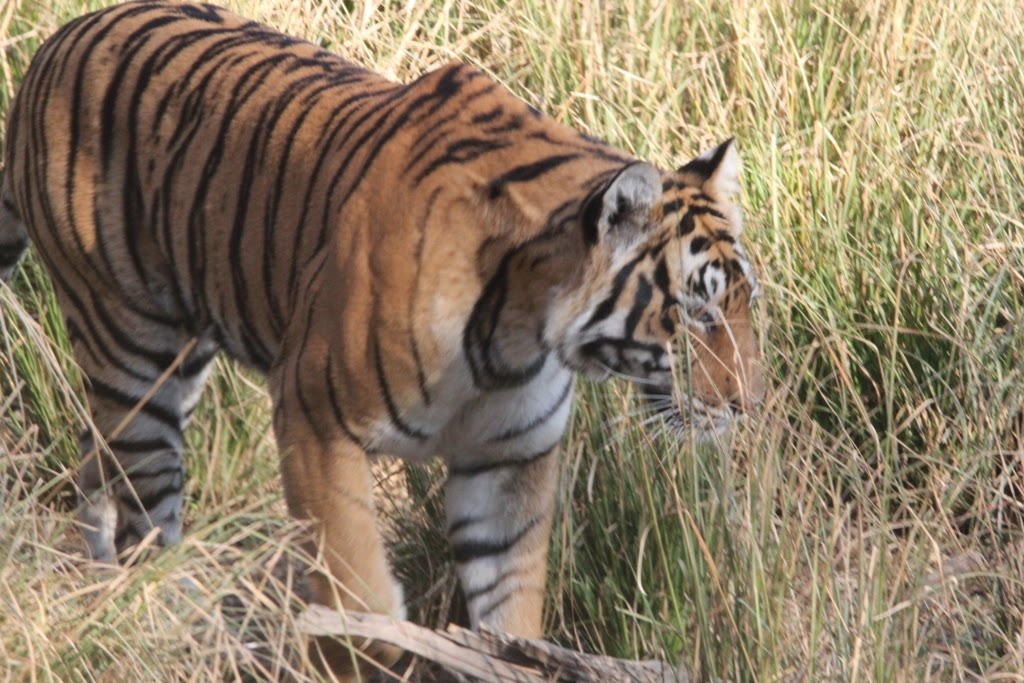
Just as we were turning a bend in the road, there was an uncharacteristic flutter in the grass around us. A few chittal who must have been grazing there emerged and leapt away from the grass, as did several pea-fowl who must have been grazing inside the grass. A roar sounded momentarily, and we knew a tiger was hunting!

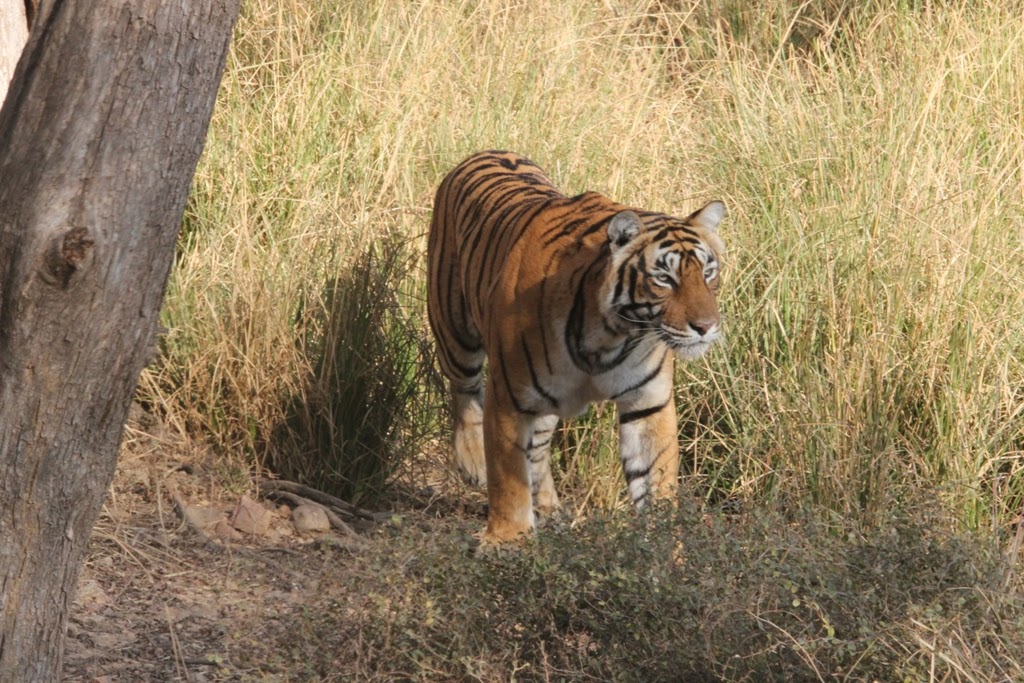
The female tiger who emerged from the grass seemed to completely ignore us as it walked past us, and several other jeeps and canters, only to quietly re-enter the long grass where it walked excellently camouflaged.


After this, we tried to re-locate it, found it sleeping inside the tall grass, and waited for her to awaken, but she never did, and so we returned to the main gate at around 6:30 p.m.

We then returned to our camp-site, where we were entertained by some locals who sang, played music and danced for us for about an hour. Lastly, we went back to the dining hall to eat our dinner. By half-past eight, we had returned to our tents, and we went to sleep by ten o'clock that night.

To read the next post, click HERE.